Biznesi
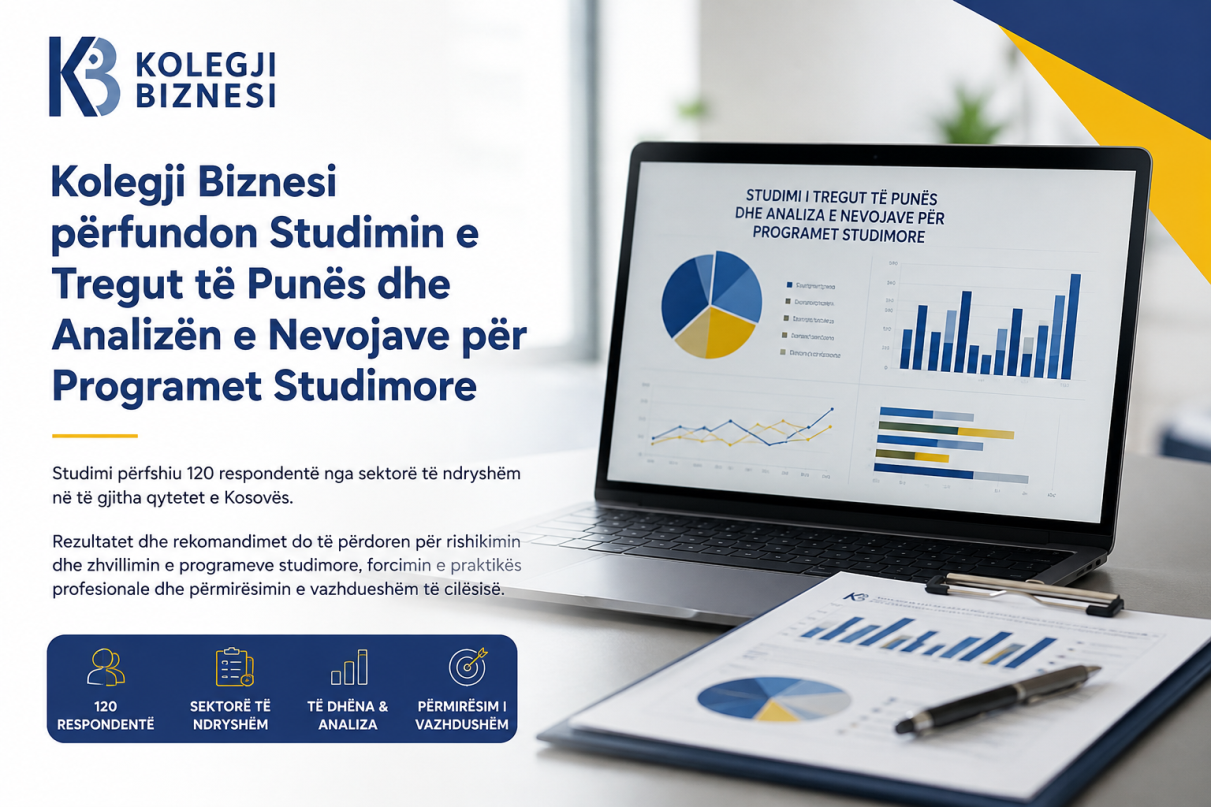
College has completed the Labour Market Study and Needs Analysis for
Study Programmes, conducted with the aim of identifying current and
future labour market needs, assessing the demand for professional profiles, and
continuously aligning study programmes with employers’ requirements.
The
study was conducted through an electronic questionnaire using the Google
Forms platform and was distributed across different cities in Kosovo.
A total of 120 respondents participated in the study,
representing private companies, public institutions, public enterprises,
non-governmental organisations, financial institutions, educational
institutions, and other organisations.
The
study analysed the demand for professionals from the study programmes offered
by Biznesi College, expectations regarding employment needs in the coming
years, the most sought-after professional profiles, competencies valued by
employers, the importance of practical experience, and developments expected to
influence the labour market.
The
results highlight the importance of developing practical and professional
skills, communication, teamwork, critical thinking, digital competencies, and
the use of contemporary technologies and artificial intelligence. The study
also demonstrates the importance employers place on practical experience during
university studies and on the continuous review of study programmes in response
to labour market developments.
The
final report includes an analysis of the results, cross-analysis of the data,
key findings, conclusions, and recommendations arising from the study.
The
results and recommendations of the study will be used within the processes of quality
assurance, review and development of study programmes, updating curricula and
course syllabi, strengthening the practical component of studies, and expanding
cooperation with employers and other stakeholders.
Through
studies of this nature, Biznesi College aims to support institutional decision-making
based on concrete data and evidence, while strengthening the connection between
its study programmes and the current and future needs of the labour market.