We want to build WB HEI capacity for international virtual collaboration as an innovative pedagogy in teaching and learning, with a focus on co-creating virtual learning spaces and course content that will boost 21st century skills and competencies and address the low cross-border collaboration among young students in the Western Balkans region
- WB HEI Students will go through virtual collaborative and interactive course design content and activities with other peers from the region and beyond. This will help them build applied and transferrable skills and knowledge very relevant for employability and career prospects in the modern labor market.
- WB HEI Academic Staff will be introduced to innovative pedagogies and will gain enhanced capacities to conduct cutting edge teaching activities through modern interactive technologies, which will increase the relevance of their teaching practices to the real needs of industry and the modern society. This will facilitate for collaborative academic activities with partner HEIs in the EU.
- WB HEI Administrative staff and other authorities will be introduced to new approaches for academic international exchange through interactive technology-based tools. They will be provided with project results and EU best practices and standards to be adopted at WB HEI institutional level, pushing for the facilitation and a formal credit recognition of virtual collaborative modules. Duration: 2023-2026


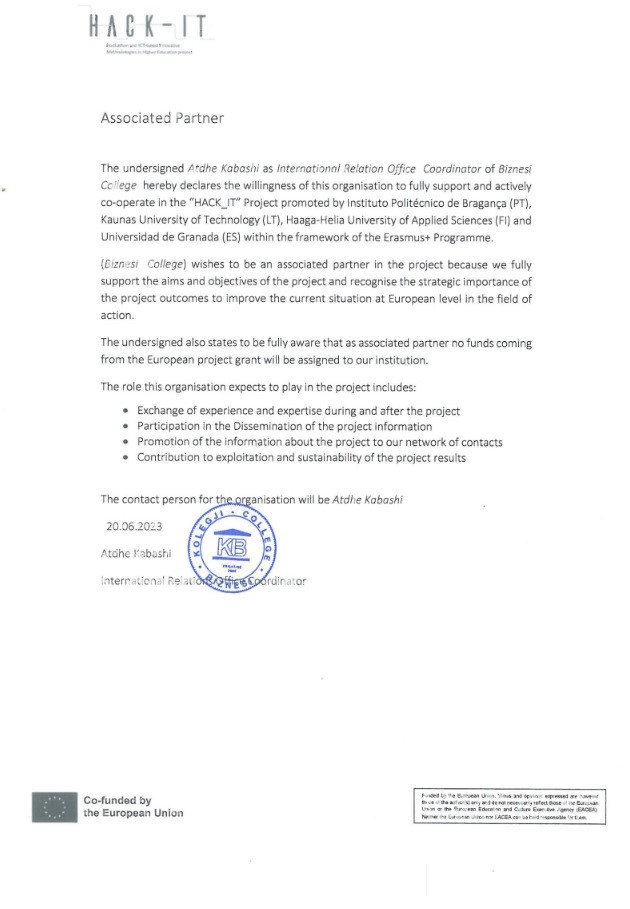
HACK-IT Project
https://hackit.ipb.pt/
Project Code
2021-1-PT01-KA220-HED-000023406
KA220-HED -
Cooperation partnerships in higher education
Acronym
HACK-IT
Project Title
Hackathon
and ICT-based Innovative Methodologies in Higher Education
Start date: 01/02/2022 End date: 31/01/2025
About
Hackathon and ICT-based Innovative Methodologies in Higher Education project will establish a
strong partnership network and a community of practice for ensuring digital readiness of the stakeholders within
and beyond the partnership.
In the current context of the current resilience demand, the project partners
acknowledge the importance of the unique challenges and experiences of every institution during the pandemic and
each partner’s expertise that let tackle the obstacles successfully.
It is more important than ever that
this expertise is shared and combined across different HEIs to maximise the learning gains and keep students
enrolled despite any obstacles they might face. Responding to the everchanging nature of the current situation
and IT advancement, a strong network of experts and the community of practice established within the project aim
to develop partnerships and resources that can be sustainably used by HEIs teachers in alignment with EU skills
agenda, Digital Education Action Plan, European Education Area (EEA).
Objectives
The project
addresses the imperatives to create more flexible and inclusive as well as secure technology enhanced open
education that can be delivered in online, blended, and distance modes of teaching/learning. The project
addresses the importance of supplementing teachers’ expertise in content knowledge with digital and pedagogical
competences to ensure high quality, active, and transformative teaching/learning.
It aims to enable
teachers to implement and develop innovative practices in education in the digital era, promote and reward
excellence in teaching and skills’ development, tackle, focus on and breach gaps and mismatches in teachers’
competences as well as develop a versatile approach to student learning in a way that will improve teacher and
student active participation and satisfaction, efficient cooperation in teaching/learning settings.
MORIN Mobility Recognition for Integration, a strand 1 CBHE multi-country project, addresses ‘Integration of
migrants’ as a regional overarching priority by focusing on academic recognition of student mobility based on
learning outcomes (LOs) as an innovative pedagogical approach, both necessary and pertinent, for linking work
with education, by ensuring curriculum transparency, comparability, flexibility for improving recognition and
study transfer procedures, revising course contents, methodologies and assessment to provide for student-centred
and skills-oriented learning that adds an international, global dimension to the curriculum, thus, enhancing
collaboration among WB6 HEIsforstudent exchange and intra-regional employability and connectivity. We follow
these interconnected paths of action:
developing documents and tools to establish a common regional approach
to academic recognition, internationalizing the curriculum via global LOs and embedded mobility, establishing
institutional procedures for the recognition of credit mobility by adopting a LOs model for enhancing
transparency, quality teaching and learning for future-proof skills, and mobility and credential completion
through credit transfer.
A regional mapping survey will be carried out. A self-assessment mobility
recognition tool, regulations for institutionwide recognition practices, guidelines for academic recognition via
LOs will be developed, the LOs of at least 5 courses from two study programmes at WB HEIs will be rewritten, 5
recognition practices, one per WB HEI, will be simulated and compared against the real ones within the
consortium. Training workshops and webinars will be organized to build the capacities of academic staff for
improving recognition practices.
WB HEIs, their staff and students, as direct beneficiaries, and other WB
universities, ministry, policy-makers, HE experts should be able to exploit the project deliverables and
integrate them into their HE contexts Project duration: 24 months
Keywords:
- Promotion of employability
- Identification of skills needs
- recognition of qualifications
- mobility (virtual, physical and blended)
- Globalisation, Migration
- European education area
Project name: Mobility recognition for integration
Project acronym: MORIN
Participants:
University of Vlora
European University of Tirana
Professional College of Tirana
Biznesi College
AAB College
Palacký University Olomouc
University St Kliment Ohridski Bitola
University of Nis
The higher education sectors in Albania and Kosovo are facing transformative challenges, aiming to create impactful experiences for students and society. However, progress is hindered by limited leadership capacity. To address this, a joint leadership and development programme (NLDP) has been initiated. This programme focuses on governance, strategic planning, and management, providing learning through networking, lectures, action learning, and staff training workshops.
During the project, 25 leaders from Albanian and Kosovan universities will benefit, with a ripple effect expected to enhance leadership capacity across more institutions over time. A leadership symposium will also ensure ongoing support, strengthening reform efforts in the higher education landscape of Albania and Kosovo.
1.UNIVERSITY COLLEGE BEDER (BEDER),
2. WESTERN BALKANS UNIVERSITY (WBU),
3. TURGUT OZAL EDUCATION SHA (EPOKA),
4. KOLEGJI BIZNESI (CB),
5. UNIVERSITY ISA BOLETINI IN MITROVICA (UIBM),
6. MEDNARODNA FAKULTETA ZA DRUZBENE IN POSLOVNE STUDIJE ZAVOD (ISSBS)
7. PEGASO INTERNATIONAL LTD (PEGASO),
STEM-EdTech
Project
STEM-EdTech aims to modernise higher education in Albania
and Kosovo by integrating digital technologies, game-based learning,
immersive tools, and innovative STEM teaching methods.
The project will:
- Strengthen digital and STEM
competences of students and academic staff.
- Introduce innovative tools such as game-based
learning, simulation, and Minecraft Education.
- Establish Digital STEM EdTech Labs
to support hybrid and distance learning.
- Modernise STEM curricula in line with labour-market
and industry needs.
- Improve student employability,
entrepreneurship, creativity, and problem-solving skills.
- Promote inclusive and equitable access
to digital STEM education, particularly for rural and vulnerable learners.
- Strengthen cooperation between higher
education, industry, public institutions, and civil society.
- Support the digital transformation and
long-term capacity of higher education institutions in the Western
Balkans.
Implementation
period:2026-2029
Partners
Higher Education
Institutions
- Kolegji Biznesi – Kosovo (
Coordinator)
- University Kadri Zeka – Kosovo
- European University of Tirana – Albania
- Tirana College of Technology – Albania
- International School for Social and
Business Studies – Slovenia
- University of Salento – Italy
- University of Vigo – Spain
Industry, Private Sector
& Civil Society
- Digital Schools Prizren Sh.p.k – Kosovo
- GreenPact Solutions – Albania
- Nexus – Albania
- NGO Development Research Innovation and
Training – Kosovo
- NGO Europe Center
Public & Associated
Partners
- ASCAL – Albanian Agency for Quality
Assurance
- Kosovo Accreditation Agency (KAA)
- Ministry of Education – Kosovo
- Ministry of Education – Albania
- Chamber of Commerce and Industry of
Durrës – Albania
- Chamber of Commerce and Industry of
Kosovo
- DXA Solutions – Kosovo
STEM-EdTech connects
education, technology, industry and public institutions to build a more
innovative, inclusive and employment-oriented digital future for higher
education.